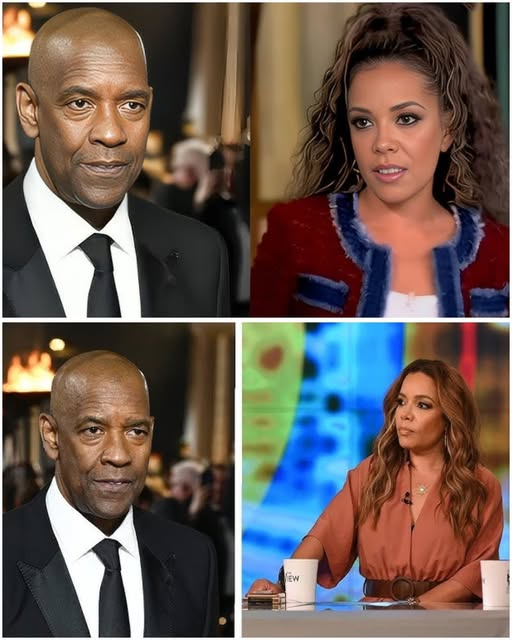
There are moments in life when silence speaks louder than sound, when composure carries more strength than aggression, and when presence alone is enough to command the room. The photograph before us is not just a snapshot of familiar faces, but a reflection of something deeper—a timeless truth about dignity, leadership, and the rare ability to influence without force. Denzel, dressed in a classic black suit, stands as the embodiment of that truth. He didn’t shout. He didn’t flinch. He didn’t even raise his voice. And yet, when he finally chose to speak, the air itself seemed to shift, and the room fell utterly silent.
What gives certain people this rare authority? It is not simply fame, nor wealth, nor even accomplishment. It is the quiet discipline of restraint. In an age where noise dominates, where arguments are won by volume rather than reason, here is a man who demonstrates that the opposite is true. His strength comes not from raising his voice, but from lowering it. His influence does not rely on defense or justification, but on certainty—certainty in who he is, certainty in the truth he carries, and certainty that words spoken calmly and clearly will always resonate longer than those shouted in haste.
In the image, the women sitting across from him reflect this unspoken reality. They are attentive, their expressions thoughtful. They do not interrupt, nor do they challenge. Instead, they listen. It is not submission, but respect. It is not silence out of fear, but silence out of recognition—recognition that they are in the presence of someone who has mastered the art of measured speech. His stillness is not weakness. It is power contained, controlled, and released only when necessary.
This moment teaches us something about leadership. Leadership is not about dominating others or demanding obedience. True leadership is about presence—the ability to carry yourself with such quiet assurance that others lean in to hear you, not because you force them, but because they choose to. In this way, Denzel becomes a symbol not only of cinematic gravitas but of human truth: that the strongest voices are often the calmest.
Think of the times in history when silence has carried weight. A courtroom that falls quiet when the verdict is about to be read. A congregation that bows its head in prayer. A classroom where students wait for the teacher’s words of wisdom. In each case, silence does not signify emptiness—it signifies anticipation, respect, and the acknowledgment that something meaningful is about to happen. That same atmosphere is captured here, not with sound, but with stillness.
When Denzel finally speaks, his words are not rushed or defensive. He doesn’t justify himself, nor does he try to win approval. His speech is deliberate, each sentence carefully chosen. And this is why his message lingers. People forget noise, but they remember clarity. They forget arguments, but they remember truths spoken with conviction. A man who does not flinch before speaking is a man whose words are grounded in certainty. And certainty, in a world of constant doubt, is magnetic.
The black suit he wears becomes symbolic. Black—timeless, steady, elegant—mirrors his demeanor. There is no excess, no need for flamboyance, no sign of weakness. Just as his words are measured, so too is his appearance: precise, restrained, and deeply intentional. His eyes, sharp and unwavering, carry the weight of someone who knows he doesn’t need to do more. Sometimes, less is infinitely more.
The women in the image play an equally important role in this narrative. Their body language reveals the impact of his composure. One sits with her hands poised, absorbing every word. Another gazes with quiet intensity, as if processing something profound. Together, they symbolize the audience—the listeners who understand that silence and attention are the highest forms of respect one can give. This is not about gender or status. It is about human recognition of authority when it is real and undeniable.
What can we learn from this? In a world where conversations often spiral into arguments, where voices rise and tempers flare, this moment shows us a different path. Denzel does not need to win by being louder. He wins by being truer. He does not crush opposition by force. He dissolves it by clarity. He does not defend himself because truth does not require defense—it stands on its own.
There is a lesson here for leaders, for speakers, for anyone navigating the noisy storms of modern life. You do not need to shout to be heard. You do not need to defend yourself endlessly to prove your worth. You do not need to flinch when challenged. What you need is presence. What you need is certainty. What you need is the courage to let silence work for you, and then, at the right moment, to speak with conviction.
And this is why the room fell silent. Not because of intimidation. Not because of authority imposed from above. But because of respect freely given. The kind of respect that only comes when words are few, but meaningful. The kind of respect that recognizes composure as a form of strength. The kind of respect that acknowledges that true influence is not about overpowering, but about drawing people in.
The photograph freezes this dynamic perfectly. You can almost hear the silence. You can almost feel the shift in the air as eyes turn and ears focus. You can sense the gravity of the moment, the way anticipation builds before words are spoken. And when those words come, they carry weight—not because they are loud, but because they are true.
He didn’t shout. He didn’t flinch. He didn’t defend himself. And yet, when Denzel spoke, the room fell silent. This is not just a story about one man. It is a story about how we, too, can reclaim the power of silence in our own lives. In a noisy world, silence is radical. In a defensive world, restraint is courageous. In a world of constant performance, authenticity is rare.
So let us remember this moment. Let us remember that real strength is not in noise but in presence. Let us remember that true power is not in defense but in certainty. Let us remember that when words are measured, silence is respected, and truth is spoken, the world listens. The room falls silent—not because it must, but because it chooses to.