hicago, 1996 — On a summer afternoon at outside Chicago, an ordinary day of family visits and animal watching turned into an event that captured the world’s attention and reshaped public perceptions of both zoos and the creatures they house
Family games
A 3-year-old boy, visiting with his mother, climbed the barrier of the zoo’s gorilla enclosure and tumbled 18 feet into the habitat. The fall knocked him unconscious. Panic spread among onlookers as the boy lay motionless on the concrete floor, dangerously close to seven western lowland gorillas — powerful animals capable of killing with ease.
he Incident
Witnesses recall the hush that fell over the zoo as people gasped at the sight of the child lying among the gorillas. Some screamed, others cried, and many feared the worst. Zoo staff rushed into action, but their entry into the enclosure carried risks — not only for the boy but also for the gorillas, who might react defensively.
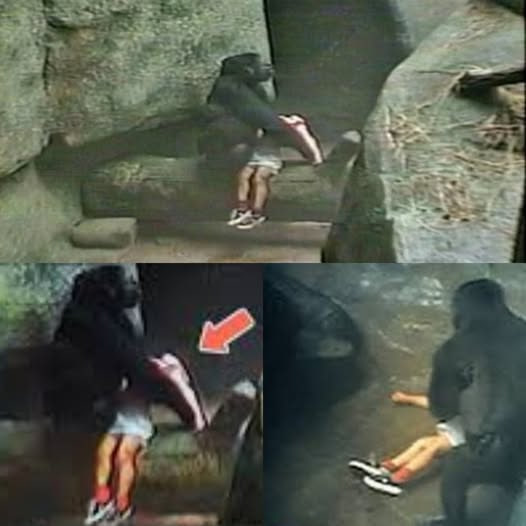
The gorilla group stirred with curiosity, but one individual stepped forward: Binti Jua, an 8-year-old female gorilla who was carrying her 17-month-old baby on her back.
Instead of aggression, she displayed an astonishing calm. Binti approached the child, bent down, and gently cradled him in her arms. She held the unconscious boy close, shielding him from the others. After a few tense minutes, she carried the child to a door where zookeepers could safely reach him.
The boy was rescued, rushed to the hospital, and later recovered. The hero of the day was not a human — but a gorilla.
Who Was Binti Jua?

Binti Jua, whose name means “Daughter of Sunshine” in Swahili, was born at Brookfield Zoo in 1988. She was the niece of Koko, the famous gorilla who learned to communicate using sign language.
Unlike Koko, Binti was not known for linguistic feats — but for something more profound: maternal instinct and empathy. Raised partly by humans after being rejected by her own mother, she had received extensive training in mothering behaviors. Zookeepers prepared her by giving her a stuffed animal to practice holding, then gradually introducing her to real infants. By the time of the 1996 incident, she was already a devoted mother to her baby, Koola.
That day, she carried not only her daughter but also the weight of human expectation — unknowingly becoming a symbol of compassion.
A World Stunned
The news spread rapidly, first across Chicago and then around the world. Television stations replayed the footage captured by zoo visitors. Headlines hailed her as a heroine:
- “Gorilla Cradles Boy, Saves His Life”
- “Gentle Giant Shows Compassion”
- “Binti Jua, The Heroine of Brookfield Zoo”
For many, the story was astonishing because it challenged assumptions about “dangerous” wild animals. The narrative was not one of savagery but of gentleness, maternal care, and an instinct to protect.
Letters poured into the zoo. Some people sent flowers. Others sent toys for Binti. Parents told their children the story as a lesson in kindness.
The Science of Empathy
Primatologists and psychologists quickly weighed in. Was this empathy, instinct, or training?
Dr. Frans de Waal, a primatologist at Emory University, suggested that gorillas and other great apes are capable of what humans call empathy. “They recognize distress,” he said, “and they sometimes take steps to comfort others, even across species.”
Others noted that Binti’s training in mothering may have played a role. Having been taught to carry infants carefully, she may have extended the same behavior toward the unconscious child.
But even if training was part of it, scientists agreed: the decision to protect rather than harm was remarkable. After all, gorillas are immensely strong animals. A misplaced grip or a flick of irritation could have killed the boy instantly. Instead, Binti held him with extraordinary tenderness.
Echoes of Similar Incidents
The rescue was not the first time a gorilla had shown compassion to a child. In 1986, at the Jersey Zoo in the UK, a 5-year-old boy fell into a gorilla enclosure and lost consciousness. A silverback named Jambo sat protectively beside the boy until rescuers arrived. That story, too, made international headlines.
These rare events fueled debates about the emotional depth of great apes. Were they acting from instinct? Or did they recognize vulnerability and respond with compassion much as humans would?
Public Perceptions of Zoos
Binti Jua’s act also reshaped conversations about zoos. At a time when animal rights activists were increasingly critical of keeping animals in captivity, the incident provided a narrative of connection rather than division.
Visitors saw gorillas not as caged beasts but as beings with emotional intelligence. Attendance at Brookfield Zoo surged in the aftermath, as families came hoping to glimpse the famous gorilla. For years, Binti remained a beloved symbol of the zoo, her story retold to new generations of visitors.
Family games
Compassion Without Borders
Perhaps the most enduring legacy of Binti’s act was the way it transcended species boundaries. People across the world, from Chicago suburbs to distant continents, saw in her behavior a reflection of the best of humanity.
Religious leaders cited her as an example of compassion present in all creation. Educators used her story to teach children about empathy. Scientists pointed to her as evidence of the evolutionary roots of moral behavior.
In an era when news often focused on violence and division, this was a story that united.
The Boy’s Recovery
The boy, whose family requested privacy, recovered from his injuries. Though he bore physical scars from the fall, he also carried a unique story — that his life had been saved by a gorilla. His identity has remained largely protected over the years, allowing him to grow up without the burden of global attention.
Family games
Legacy of Binti Jua
Binti Jua lived on as a quiet celebrity. She continued to raise her daughter Koola, who in turn became a mother, extending the family line. Visitors often pointed to her enclosure with reverence, remembering “the day she saved the boy.”
Her legacy is one of hope: that compassion is not solely a human trait, but one shared across the great tree of life.
As animal welfare science advanced in the decades following, Binti’s act was often invoked in arguments for recognizing the cognitive and emotional capacities of great apes. Some activists pushed for legal protections recognizing them as “non-human persons.” While such efforts remain controversial, the symbolic power of her story is undeniable.
A Reminder for Humanity
Nearly three decades later, the image of Binti Jua holding that unconscious child remains etched in memory. It is a story told in classrooms, in documentaries, and in discussions about empathy.
Family games
In a world often fractured by conflict, inequality, and cruelty, the actions of an 8-year-old gorilla remind us of a profound truth: compassion is not bound by species, language, or culture. It is a universal force, present even in places we least expect it.
On that day in 1996, at Brookfield Zoo, the bars of an enclosure did not divide us from another species. Instead, they opened a window into our shared capacity for care.