In a groundbreaking announcement that has sent shockwaves through the scientific community and
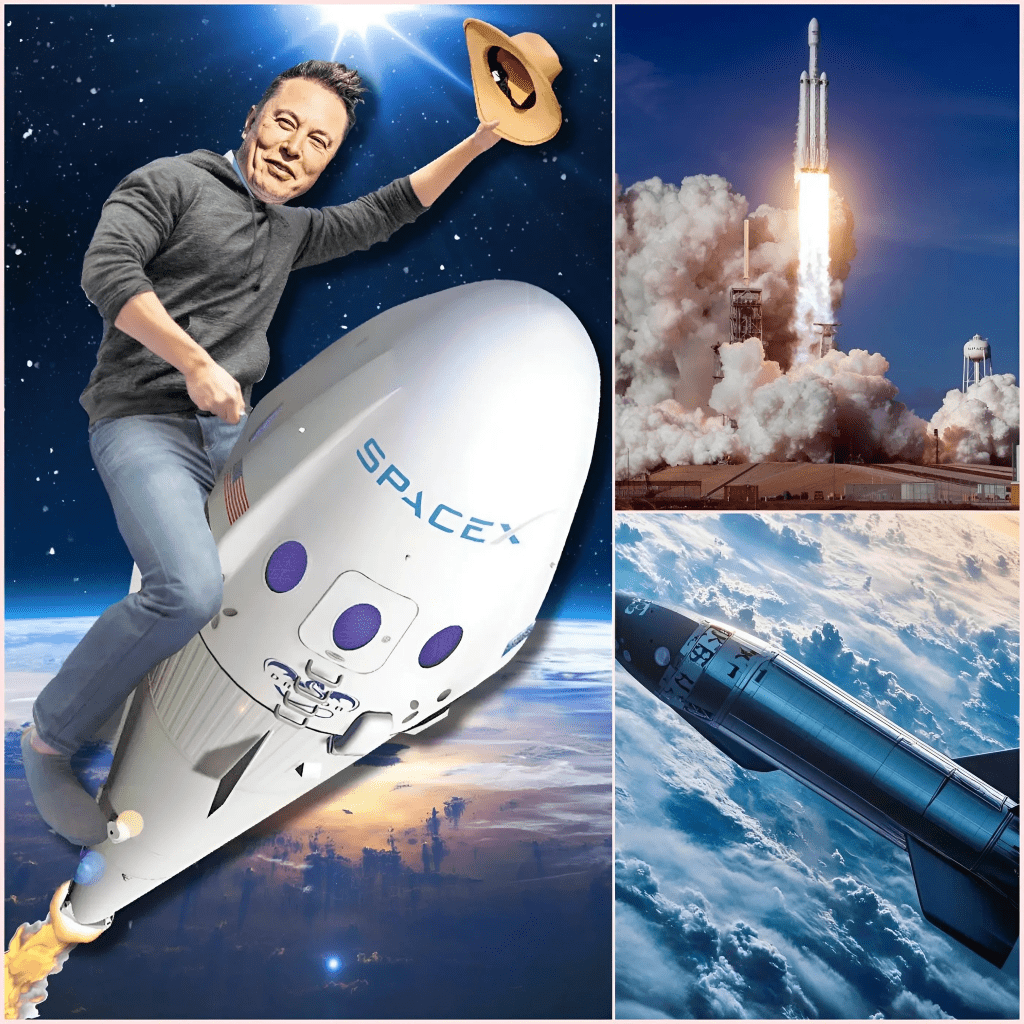
beyond, SpaceX, the pioneering aerospace company founded by Elon Musk, claims to have developed a revolutionary spacecraft capable of exceeding the speed of light. This audacious revelation, if proven true, could redefine humanity’s relationship with the cosmos, opening doors to interstellar exploration previously confined to the realm of science fiction. The unveiling of this purported technology marks a pivotal moment in Musk’s relentless quest to make humanity a multi-planetary species, cementing his legacy as a visionary who dares to challenge the boundaries of physics.
The announcement, made during a highly anticipated SpaceX press conference on May 10, 2025, at the company’s Starbase facility in Texas, was met with a mixture of awe, skepticism, and intrigue. Musk, known for his bold proclamations, took the stage to describe a propulsion system that defies conventional understanding. Dubbed the “ChronoDrive,” this experimental engine is said to harness exotic energy fields to manipulate spacetime, enabling velocities that surpass the cosmic speed limit of 670,616,629 miles per hour established by Einstein’s theory of special relativity. While Musk remained tight-lipped about the technical specifics, citing proprietary concerns and ongoing research, he hinted at inspirations drawn from theoretical concepts like the Alcubierre warp drive, which proposes moving a spacecraft by contracting spacetime ahead and expanding it behind.

SpaceX’s claim arrives at a time when the company is already pushing the envelope of space exploration. With its Starship program, SpaceX has achieved remarkable milestones, including reusable rocket technology and plans for lunar and Martian missions. The ChronoDrive, however, represents a quantum leap forward. According to SpaceX engineers, the technology is still in its early stages, with prototype testing scheduled for 2026. These tests aim to demonstrate controlled acceleration beyond relativistic speeds in a vacuum environment, potentially using the company’s advanced facilities in low-Earth orbit. If successful, the implications are staggering: a journey to Mars could take mere minutes, and the nearest star system, Alpha Centauri, could be reachable within a human lifetime.
Skeptics, however, urge caution. The scientific community has long held that faster-than-light travel is impossible due to the immense energy requirements and paradoxes posed by relativity, such as time dilation and infinite mass. Dr. Emily Chen, a theoretical physicist at MIT, expressed doubts, stating, “While SpaceX’s ambition is commendable, the energy needed to warp spacetime on this scale would dwarf the output of entire stars. Without transparent data, this sounds more like a publicity stunt than a breakthrough.” Others point to past controversies, such as unverified claims about Musk’s projects, suggesting that the announcement may be a strategic move to bolster investor confidence amid SpaceX’s costly Starship setbacks, including two high-profile explosions in early 2025.
Despite the skepticism, Musk’s track record lends credence to his vision. SpaceX has consistently defied expectations, from landing reusable Falcon 9 boosters to launching the Starlink constellation, which now provides global internet coverage. The company’s iterative approach—often described as “fail fast, learn fast”—has revolutionized the aerospace industry. Supporters argue that even if the ChronoDrive falls short of light-speed capabilities, its development could yield transformative technologies, such as more efficient propulsion systems or novel energy sources. “Musk doesn’t just think outside the box; he obliterates it,” said aerospace analyst Laura Forczyk. “Even partial success could change the game.”

The broader implications of this announcement extend beyond technology. Economically, a light-speed spacecraft could unlock new markets, from rapid interplanetary logistics to asteroid mining. Geopolitically, it could intensify the space race, with nations like China and private competitors like Blue Origin scrambling to match SpaceX’s pace. Ethically, questions arise about the environmental impact of such energy-intensive systems and the societal consequences of prioritizing cosmic expansion over terrestrial challenges. Musk, however, remains undeterred, framing the ChronoDrive as a step toward ensuring humanity’s survival. “The universe is vast, but our time is finite,” he said. “We must become a spacefaring civilization or risk extinction.”
As the world awaits concrete evidence, the ChronoDrive has already ignited imaginations. Social media platforms, particularly X, are abuzz with speculation, ranging from memes about “Star Trek becoming reality” to debates over the physics of warp travel. SpaceX has promised updates, including a white paper in late 2025, which could shed light on the ChronoDrive’s feasibility. For now, Musk’s latest gambit underscores his unparalleled ability to capture the zeitgeist, blending innovation with spectacle. Whether the ChronoDrive propels humanity to the stars or remains a tantalizing dream, it has already achieved one feat: reminding us that the impossible is often just a matter of time.