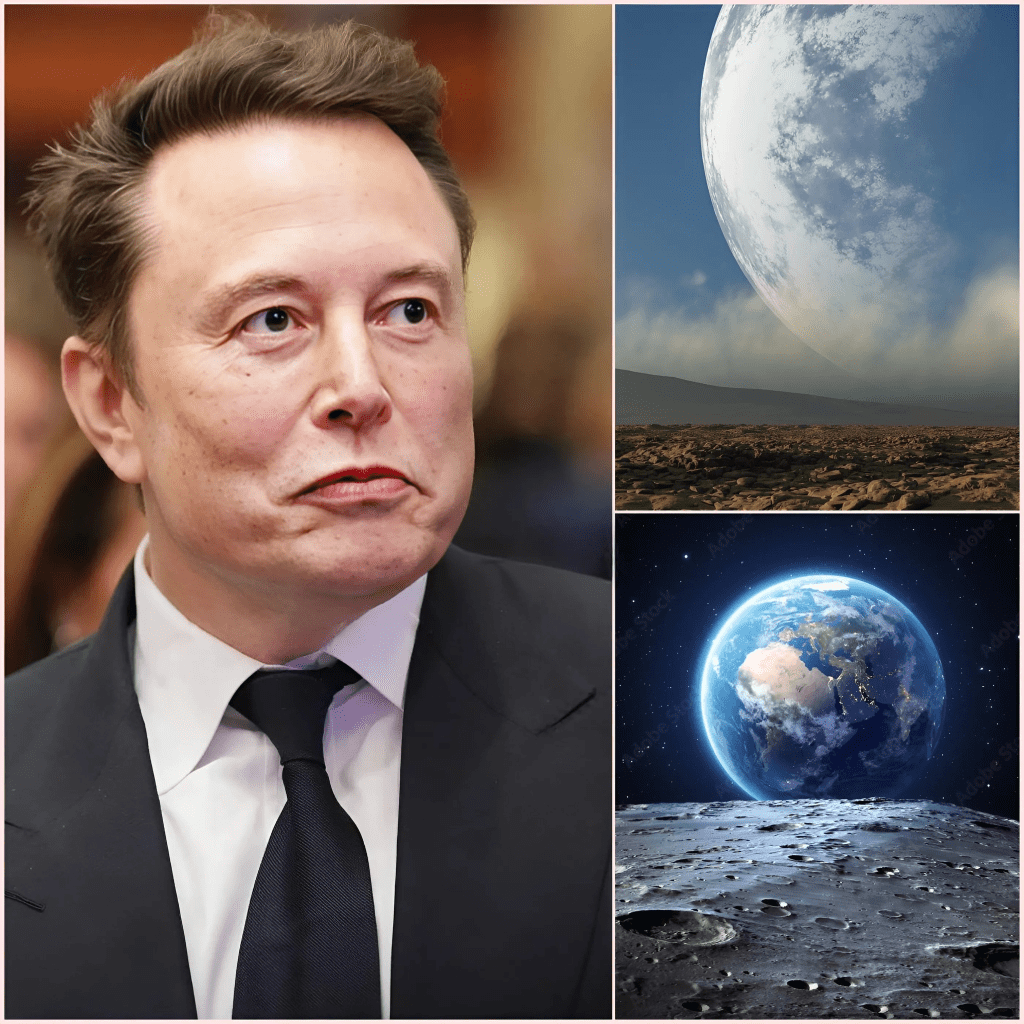
In a shocking statement that has sent ripples across the scientific community and beyond, Elon Musk, the visionary CEO of SpaceX and Tesla, has claimed that the Moon is gradually moving closer to Earth each year, potentially leading to catastrophic consequences for humanity. The announcement, made via a post on X, has sparked intense debate, with experts scrambling to verify the claims and assess their implications. While Musk is known for his bold and often controversial statements, this warning has raised eyebrows due to its alarming tone and the lack of immediate scientific consensus supporting it. As the world grapples with this unsettling possibility, the question remains: is this a genuine cause for concern, or is Musk once again pushing the boundaries of speculation to draw attention to his ambitious space agenda?
Musk’s statement comes at a time when his influence in both the private and public sectors is at an all-time high. As the head of SpaceX, he has revolutionized space travel with reusable rockets and plans for Mars colonization. His recent role in the U.S. government’s Department of Government Efficiency has further amplified his voice on global issues. In his post, Musk suggested that the Moon’s gradual approach could disrupt Earth’s delicate environmental balance, potentially triggering catastrophic events such as intensified tidal forces, extreme weather patterns, and even geological instability. He emphasized that humanity must accelerate its efforts to become a multi-planetary species to ensure survival in the face of such cosmic threats. “We cannot ignore the Moon’s trajectory,” Musk wrote. “It’s a slow-motion crisis, but the consequences will be devastating if we don’t act.”

The scientific community, however, has responded with skepticism. Astronomers and astrophysicists point out that the Moon’s orbit is well-studied, and current data indicates that it is actually moving away from Earth at a rate of approximately 3.8 centimeters per year due to tidal interactions. This gradual recession has been occurring for billions of years and is not expected to reverse in the foreseeable future. Dr. Sarah Thompson, a planetary scientist at NASA’s Jet Propulsion Laboratory, stated, “There’s no evidence to suggest the Moon is moving closer to Earth. Musk’s claim contradicts decades of precise measurements from lunar laser ranging experiments.” These experiments, which involve bouncing laser beams off reflectors placed on the Moon during the Apollo missions, provide highly accurate data on the Moon’s distance from Earth.
Despite the lack of supporting evidence, Musk’s warning has ignited public imagination and fear. Social media platforms, particularly X, are abuzz with speculation about apocalyptic scenarios, from mega-tsunamis to earthquakes triggered by increased gravitational pull. Some users have even linked Musk’s statement to his long-standing advocacy for colonizing Mars, suggesting that he may be using the claim to drum up support for SpaceX’s interplanetary ambitions. Others, however, argue that Musk’s track record of predicting technological and environmental challenges—such as the need for sustainable energy or the risks of artificial intelligence—lends credibility to his concerns, even if the science is unclear.
The potential consequences of a closer Moon, while hypothetical, are indeed profound. A significant reduction in the Moon’s distance could amplify tidal forces, leading to higher and more destructive tides that could inundate coastal cities. Increased gravitational influence might also destabilize Earth’s crust, potentially triggering volcanic eruptions or earthquakes in vulnerable regions. Furthermore, changes in the Moon’s orbit could disrupt global climate patterns, exacerbating the already pressing issue of climate change. However, experts stress that such scenarios would require a dramatic and unexplained shift in the Moon’s trajectory, which is not supported by current observations.

Musk’s warning also raises questions about his motivations. Is this a genuine call to action, or a strategic move to highlight the urgency of space exploration? SpaceX is currently preparing for uncrewed Starship missions to Mars in 2026, with crewed missions planned to follow within a few years. By framing the Moon’s alleged approach as a looming threat, Musk may be seeking to galvanize public and governmental support for his vision of making humanity a multi-planetary species. Critics argue that this tactic, while effective in capturing attention, risks spreading misinformation and undermining trust in scientific institutions.
As the debate continues, one thing is clear: Musk’s ability to shape public discourse remains unparalleled. Whether his warning about the Moon proves to be a prescient alert or an overblown exaggeration, it has succeeded in sparking a global conversation about humanity’s place in the cosmos. For now, scientists are urging calm and calling for further investigation into Musk’s claims. Meanwhile, the world watches closely, wondering if this is another instance of Musk challenging the status quo—or a step too far into the realm of speculation.